Stage : Marche sur le Luo Shu
-
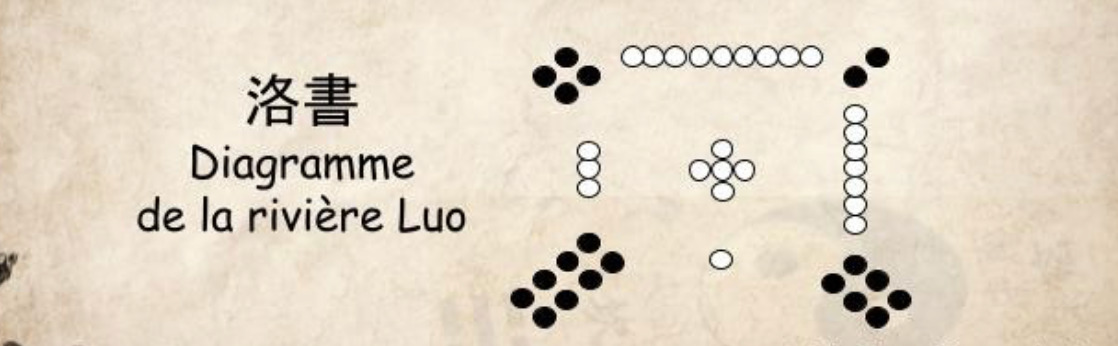
L’importance du Luo Shu, aussi appelé le « carré magique de Luo » ou encore le « Diagramme du fleuve Luo », est considérable dans la pensée taoïste, tant sur le plan théorique que pratique. Ce diagramme ancien, chargé de symbolisme cosmologique et numérologique, joue un rôle fondamental dans l’élaboration des systèmes de correspondance qui organisent l’univers selon la vision taoïste. Il constitue une des matrices majeures à partir desquelles se sont développées plusieurs disciplines, comme la cosmologie taoïste, la médecine traditionnelle chinoise, la géomancie (Feng Shui), l’astrologie chinoise, les arts divinatoires (comme le Yi Jing), ainsi que certaines formes de méditation et d’alchimie interne (nei dan).
Selon la légende chinoise, le diagramme du Luo Shu serait apparu à l’empereur mythique Yu le Grand (vers 2200 av. J.-C.), alors qu’il observait une tortue sacrée sortir des eaux du fleuve Luo. Sur la carapace de cette tortue figuraient des marques disposées selon un schéma numérique symétrique : chaque ligne, colonne et diagonale du carré formait la somme constante de 15. Ce carré magique 3x3 est devenu un symbole d’équilibre et d’ordre universel. Les neuf chiffres qu’il contient (de 1 à 9) ne sont pas de simples entiers, mais des symboles dynamiques qui traduisent des forces cosmiques en interaction, organisées selon les principes du yin et du yang, des cinq éléments (wu xing), et des directions cardinales.
Le Luo Shu est également mis en relation avec un autre diagramme fondamental, le He Tu, le Diagramme du Fleuve Jaune), plus ancien, considéré comme la carte originelle du cosmos. Tandis que le He Tu représente le monde primordial, le Luo Shu est le schéma du monde manifesté, structuré, rythmé. Ensemble, ils expriment la transformation du chaos originel (Wu Ji) vers l’ordre cosmique (Taiji), en parfaite cohérence avec la cosmogonie taoïste.
Dans la théorie taoïste, le Luo Shu permet d’exprimer les lois qui régissent le mouvement du Qi, l’énergie vitale, dans l’univers comme dans le corps humain. Chaque chiffre du carré magique est associé à une direction (nord, sud, est, ouest, centre, et les intercardinaux), à un élément (eau, feu, bois, métal, terre), à une saison, une couleur, une émotion, un organe interne, et d'autres correspondances ésotériques. Il ne s’agit donc pas seulement d’un objet mathématique, mais d’une grille d’harmonisation du macrocosme et du microcosme.
Cette organisation numérique reflète les principes de circulation énergétique dans l’univers et sert de base à des modèles dynamiques comme le Ba Gua (les huit trigrammes) ou les cycles de production et de contrôle des cinq éléments. Le Luo Shu agit donc comme un archétype mathématique du Tao : il incarne l’harmonie des opposés, la cyclicité des transformations, et l’interconnexion des êtres et des phénomènes.
Sur le plan pratique, le Luo Shu sert de fondement à plusieurs disciplines taoïstes visant l’équilibre, la santé, la clairvoyance et l’alignement avec le Tao.Dans l’art du Feng Shui, le Luo Shu est utilisé pour déterminer l’équilibre énergétique d’un espace donné. Le carré magique sert à identifier les zones favorables ou néfastes d’un lieu, selon la position des chiffres, des directions et des éléments. Il est également intégré dans la méthode du "vol des étoiles" (Xuan Kong Fei Xing), une technique d’analyse énergétique des habitations, dans laquelle le Luo Shu permet de tracer la carte du Qi temporel d’un lieu, en fonction des cycles annuels ou mensuels.
En médecine traditionnelle chinoise, les correspondances du Luo Shu sont employées pour comprendre le flux énergétique dans le corps humain, en particulier à travers les méridiens, les organes et les émotions. Chaque chiffre est lié à un organe et à un aspect psychologique, ce qui permet d’intervenir de manière énergétique ou symbolique (acupuncture, phytothérapie, Qigong) pour rétablir l’équilibre.
Dans la pratique de l’alchimie interne taoïste (nei dan), le Luo Shu peut être utilisé comme carte intérieure du corps spirituel. Il aide à structurer les étapes du raffinement des énergies internes (jing, qi, shen) en vue de la transformation spirituelle. Il sert également dans les visualisations méditatives où l’adepte parcourt les directions du carré pour aligner son souffle avec les forces cosmiques.
Le Luo Shu est aussi étroitement lié au Yi Jing (Livre des Mutations), un des textes les plus sacrés de la tradition taoïste. Les huit trigrammes du Yi Jing, et leurs soixante-quatre combinaisons hexagrammiques, trouvent une structure logique dans la disposition du Luo Shu. Les praticiens du Yi Jing s’appuient sur le carré magique pour interpréter les mutations, les équilibres et déséquilibres qui traversent une situation donnée. Le Luo Shu permet ainsi de lire les signes du Tao à travers le mouvement des chiffres, dans une logique divinatoire où l’ordre cosmique peut être consulté par le biais des nombres.
Le Luo Shu est bien plus qu’un artefact historique ou un diagramme mathématique ancien. Il constitue une clef de lecture de l’univers, dans laquelle se reflètent la structure du monde manifesté, la circulation des énergies, les cycles naturels et les transformations spirituelles. Il sert d’intermédiaire entre le chaos primordial et l’ordre du monde, entre le Tao indicible et la réalité vécue. Dans la pratique taoïste, il agit comme un miroir du corps et de l’univers, un outil de rééquilibrage, et une carte de navigation pour retourner à l’harmonie originelle.
Par son pouvoir de synthèse entre le numérique, le symbolique, le cosmique et l’humain, le Luo Shu incarne l’un des plus puissants symboles opératifs du taoïsme, capable de guider le sage aussi bien dans la contemplation métaphysique que dans l’action quotidienne, en accord profond avec le rythme du Tao.
La marche sur le Luo Shu (ou marche rituelle sur le carré magique) représente une pratique taoïste ésotérique à la fois symbolique, méditative et énergétique, qui consiste à parcourir physiquement, en suivant un ordre précis, les neuf positions du carré magique du Luo Shu. Cette pratique n’est pas une simple gymnastique spirituelle ; elle constitue une mise en mouvement du corps dans l’espace sacré du cosmos, permettant à l’adepte de réharmoniser son énergie interne avec les forces célestes et terrestres. Il s’agit, à proprement parler, d’un rituel de résonance cosmique, où le déplacement corporel devient l’acte même de marcher dans l’ordre de l’univers.
La marche sur le Luo Shu repose sur la structure du carré magique 3x3, dans lequel les neuf chiffres sont répartis selon un ordre précis :
Chaque chiffre est lié à un élément, une direction, une saison, un organe, une énergie yin ou yang, et une planète. Le pratiquant, en marchant sur ces positions selon une séquence traditionnelle, active successivement ces forces dans son propre champ énergétique. Le chiffre central (5) représente la terre et l’axe du monde — le point d’équilibre autour duquel s’organise la totalité. Il constitue le point de départ et de retour, car tout commence et finit au centre dans la logique du Tao.
Selon certaines écoles taoïstes, la marche suit l’ordre de la circulation du Qi, soit selon le cycle naturel des cinq éléments (génération ou contrôle), soit selon les directions cosmiques ou encore les rythmes du Bagua. Cette marche peut s’effectuer à l’aube, au crépuscule, ou en moments sacrés, dans un espace délimité, souvent en extérieur ou sur une plateforme circulaire symbolisant le ciel.
L’exécution de la marche sur le Luo Shu exige une grande concentration. Chaque pas est posé avec lenteur, conscience et précision, souvent accompagné de respirations synchronisées, de mudras (gestes des mains), de visualisations (énergies élémentaires ou couleurs spécifiques), voire de récitations silencieuses de mantras ou d’incantations. Il ne s’agit pas seulement de se déplacer, mais d’activer les forces internes, en alignant intention, souffle et mouvement.
L’objectif ultime de la marche sur le Luo Shu n’est pas simplement l’équilibrage énergétique, mais l’union du corps, de l’esprit et du cosmos. En suivant cette trajectoire sacrée, l’adepte répète en acte le mythe de la création : il part du centre originel (le Tao), explore les forces manifestées (les huit directions), et revient au centre, transformé par son propre voyage intérieur. C’est une alchimie en mouvement, un cheminement symbolique vers la complétude, la clarté et la communion avec le Ciel et la Terre.
Dans certaines pratiques taoïstes avancées, cette marche est intégrée à des rituels de purification, de divination, ou d’élévation spirituelle. Elle est aussi utilisée dans des cérémonies liturgiques ou initiatiques, où le déplacement sur le Luo Shu devient un acte de passage vers un état de conscience supérieur, une manière de revivre l’ordre cosmique par le biais du corps.
Outre sa dimension spirituelle, la marche sur le Luo Shu est parfois utilisée à des fins thérapeutiques. Elle aide à relancer la circulation du Qi, à corriger les déséquilibres internes et à renforcer les organes correspondant aux chiffres activés. Associée à la médecine chinoise ou au Qigong, elle devient un outil puissant de prévention et de guérison, notamment en lien avec les troubles émotionnels, les désordres digestifs, ou les déséquilibres saisonniers.
La marche sur le Luo Shu est une forme incarnée de la sagesse taoïste, une méthode par laquelle le pratiquant entre dans une danse sacrée avec les lois invisibles du cosmos. À travers ce rituel en apparence simple, il s’accorde à la musique silencieuse du Tao, retrouve l’ordre fondamental gravé dans le monde et dans son propre être, et cultive une profonde harmonie entre l’intériorité humaine et le rythme du ciel. Pratiquée avec assiduité et respect, elle devient un chemin de retour vers la source, un pont vivant entre le visible et l’invisible, entre l’homme et le Tao.
The importance of the Luo Shu, also called the “Luo magic square” or the “Luo River Diagram”, is considerable in Taoist thought, both in theory and in practice. This ancient diagram, loaded with cosmological and numerological symbolism, plays a fundamental role in the elaboration of the systems of correspondence that organize the universe according to the Taoist vision. It constitutes one of the major matrices from which several disciplines have developed, such as Taoist cosmology, traditional Chinese medicine, geomancy (Feng Shui), Chinese astrology, divinatory arts (such as Yi Jing), as well as certain forms of meditation and internal alchemy (nei dan).
According to Chinese legend, the Luo Shu diagram appeared to the mythical emperor Yu the Great (around 2200 BC) as he watched a sacred turtle emerge from the waters of the Luo River. On the shell of this turtle were marks arranged in a symmetrical numerical pattern: each row, column and diagonal of the square formed the constant sum of 15. This magic 3x3 square has become a symbol of balance and universal order. The nine numbers it contains (from 1 to 9) are not simple integers, but dynamic symbols that translate interacting cosmic forces, organized according to the principles of yin and yang, the five elements (wu xing), and the cardinal directions.
Luo Shu is also related to another fundamental diagram, the He Tu (Yellow River Diagram), which is older and considered to be the original map of the cosmos. While the He Tu represents the primordial world, the Luo Shu is the diagram of the manifested, structured and rhythmic world. Together, they express the transformation of the original chaos (Wu Ji) into cosmic order (Taiji), in perfect coherence with Taoist cosmogony.
In Taoist theory, Luo Shu allows the laws that govern the movement of Qi, the vital energy, in the universe as in the human body, to be expressed. Each number in the magic square is associated with a direction (north, south, east, west, center, and the intercardinal directions), an element (water, fire, wood, metal, earth), a season, a color, an emotion, an internal organ, and other esoteric correspondences. It is therefore not just a mathematical object, but a grid for harmonizing the macrocosm and the microcosm.
This numerical organization reflects the principles of energy circulation in the universe and serves as the basis for dynamic models such as the Ba Gua (the eight trigrams) or the cycles of production and control of the five elements. Luo Shu therefore acts as a mathematical archetype of the Tao: it embodies the harmony of opposites, the cyclical nature of transformations, and the interconnection of beings and phenomena.
In practical terms, Luo Shu serves as the basis for several Taoist disciplines aimed at achieving balance, health, clairvoyance and alignment with the Tao.In the art of Feng Shui, Luo Shu is used to determine the energy balance of a given space. The magic square is used to identify favorable or harmful areas of a place, according to the position of the numbers, directions and elements. It is also integrated into the “star theft” method (Xuan Kong Fei Xing), a technique for analyzing the energy of homes, in which Luo Shu is used to map the temporal Qi of a place, according to annual or monthly cycles.
In traditional Chinese medicine, the correspondences of Luo Shu are used to understand the flow of energy in the human body, in particular through the meridians, organs and emotions. Each number is linked to an organ and a psychological aspect, which allows for intervention in an energetic or symbolic way (acupuncture, herbal medicine, Qigong) to restore balance.
In the practice of Taoist internal alchemy (nei dan), Luo Shu can be used as an inner map of the spiritual body. It helps to structure the stages of refinement of internal energies (jing, qi, shen) for spiritual transformation. It is also used in meditative visualizations where the practitioner moves through the directions of the square to align his breath with cosmic forces.
Luo Shu is also closely linked to the I Ching (Book of Changes), one of the most sacred texts of the Taoist tradition. The eight trigrams of the I Ching, and their sixty-four hexagram combinations, find a logical structure in the layout of Luo Shu. I Ching practitioners rely on the magic square to interpret the changes, balances and imbalances that occur in a given situation. Luo Shu thus makes it possible to read the signs of the Tao through the movement of the figures, in a divinatory logic where the cosmic order can be consulted through numbers.
Luo Shu is much more than a historical artifact or an ancient mathematical diagram. It is a key to understanding the universe, in which the structure of the manifested world, the circulation of energies, natural cycles and spiritual transformations are reflected. It serves as an intermediary between primordial chaos and the order of the world, between the unspeakable Tao and lived reality. In Taoist practice, it acts as a mirror of the body and the universe, a tool for rebalancing, and a navigation chart for returning to original harmony.
Through its power of synthesis between the numerical, the symbolic, the cosmic and the human, the Luo Shu embodies one of the most powerful operative symbols of Taoism, capable of guiding the sage both in metaphysical contemplation and in daily action, in deep harmony with the rhythm of the Tao.
Walking on the Luo Shu (or ritual walking on the magic square) is an esoteric Taoist practice that is symbolic, meditative and energetic, which consists of physically walking through the nine positions of the Luo Shu magic square in a specific order. This practice is not simply spiritual gymnastics; it involves setting the body in motion in the sacred space of the cosmos, allowing the practitioner to re-harmonize his internal energy with celestial and terrestrial forces. Strictly speaking, it is a ritual of cosmic resonance, where bodily movement becomes the very act of walking in the order of the universe.
Walking on the Luo Shu is based on the structure of the 3x3 magic square, in which the nine digits are arranged in a specific order:
Each digit is linked to an element, a direction, a season, an organ, a yin or yang energy, and a planet. The practitioner, by walking on these positions according to a traditional sequence, successively activates these forces in their own energy field. The central number (5) represents the earth and the axis of the world - the point of balance around which everything is organized. It is the point of departure and return, because everything begins and ends at the center in the logic of the Tao.
According to certain Taoist schools, the walk follows the order of the circulation of Qi, either according to the natural cycle of the five elements (generation or control), or according to the cosmic directions or the rhythms of the Bagua. This walk can be done at dawn, at dusk, or at sacred moments, in a delimited space, often outdoors or on a circular platform symbolizing the sky.
Performing the Luo Shu walk requires great concentration. Each step is taken slowly, consciously and precisely, often accompanied by synchronized breathing, mudras (hand gestures), visualizations (elemental energies or specific colors), or even silent recitations of mantras or incantations. It is not just a question of moving, but of activating internal forces, by aligning intention, breath and movement.
The ultimate goal of walking on Luo Shu is not simply energy balancing, but the union of body, mind and cosmos. By following this sacred path, the practitioner reenacts the myth of creation: they start from the original center (the Tao), explore the manifested forces (the eight directions), and return to the center, transformed by their own inner journey. It is alchemy in motion, a symbolic journey towards wholeness, clarity and communion with Heaven and Earth.
In certain advanced Taoist practices, this walking is integrated into purification, divination or spiritual elevation rituals. It is also used in liturgical or initiation ceremonies, where moving on the Luo Shu becomes an act of passage to a higher state of consciousness, a way of reliving the cosmic order through the body.
In addition to its spiritual dimension, walking on Luo Shu is sometimes used for therapeutic purposes. It helps to boost the circulation of Qi, correct internal imbalances and strengthen the organs corresponding to the activated numbers. Combined with Chinese medicine or Qigong, it becomes a powerful tool for prevention and healing, particularly in relation to emotional and digestive disorders, or seasonal imbalances.
Luo Shu walking is an embodied form of Taoist wisdom, a method by which the practitioner enters into a sacred dance with the invisible laws of the cosmos. Through this apparently simple ritual, he tunes in to the silent music of the Tao, rediscovers the fundamental order engraved in the world and in his own being, and cultivates a deep harmony between human interiority and the rhythm of the sky. Practiced with diligence and respect, it becomes a path back to the source, a living bridge between the visible and the invisible, between man and the Tao.
-
Deleted by
 Le Professeur
 -
Restored by Le Professeur